
 ● LIVE
Live view from Prague.
Watch Prague in real time from two complementary viewpoints: the Gothic gateway of Charles Bridge and the railway city in motion.
4 webcams onlineSelect a live view: the Play button opens the dedicated page for that specific camera.
The map connects the live viewpoints with the historic and transport landmarks that help explain central Prague.
Prague is especially well suited to a live-webcam guide because its historic centre can be read through a small number of strong urban axes: the Vltava River, Charles Bridge, the Old Town streets and the transport corridors that connect the centre with the rest of the city. The webcams currently collected by Webcam OK show two very different sides of Prague: the monumental approach to Charles Bridge and a railway view linked to the city’s main transport system.
These viewpoints complement one another. The bridge-tower camera belongs to the symbolic heart of Prague, where Gothic architecture, the river and the old royal route meet. The railway camera shows a working city rather than a postcard: trains, platforms, infrastructure and daily movement. Together they make it possible to see Prague as both a historic capital and a modern European transport hub.
This guide connects the live images with the places around them. It explains the Old Town Bridge Tower, Charles Bridge, the Vltava, the route toward Old Town Square, Wenceslas Square and Prague Main Railway Station, and suggests what changes are worth observing in real time: light, river weather, pedestrian density, train movement and the contrast between the medieval skyline and contemporary urban life.
History, landscape and landmarks that help interpret what appears in the live images.
The Old Town Bridge Tower stands at the Old Town end of Charles Bridge and is one of Prague’s most important Gothic landmarks. Prague City Tourism describes it as one of the most beautiful Gothic gateways in the world. It was created in the second half of the 14th century in connection with Charles Bridge and the building programme of Emperor Charles IV, following the design tradition of Petr Parléř.
The tower was not only defensive or decorative. It also formed a ceremonial entrance to the Old Town and functioned as a symbolic triumphal arch on the coronation route of Czech kings. Its sculptural programme, pointed gateway and vertical profile make it a key element for reading a webcam view around the bridge: even when the camera angle changes, the tower helps orient the scene between Old Town, the river and the bridge.
Charles Bridge crosses the Vltava between the Old Town and Malá Strana. The present stone bridge was built after the earlier Judith Bridge was destroyed by flooding in 1342. Since 1870 it has officially carried the name Charles Bridge. Its sandstone structure is closed at both ends by bridge towers, and a long sequence of statues and sculptural groups was added mainly between the late 17th and early 20th centuries.
A live view makes the bridge easier to understand than a still photograph. The number of pedestrians changes dramatically through the day, mist can soften the opposite bank, low sunlight can emphasise the statues and towers, and rain or snow changes the colour of the paving. River conditions also influence the atmosphere. The bridge is therefore both a monument and a stage on which Prague’s daily rhythm remains visible.
From the Old Town Bridge Tower, the natural route continues through the narrow streets of Staré Město toward Old Town Square. This is one of the most concentrated historic areas in Prague: medieval street lines, Baroque façades, church towers and later civic buildings coexist within a short walk.
Old Town Hall was established in 1338, and its astronomical clock became one of the best-known symbols of the city. The clock mechanism dates back to the early 15th century and the square remains a major meeting place. Although it is not necessarily visible in the bridge webcam, it helps explain where the pedestrian flow from Charles Bridge is heading and why the surrounding streets can become particularly busy at different times of day.
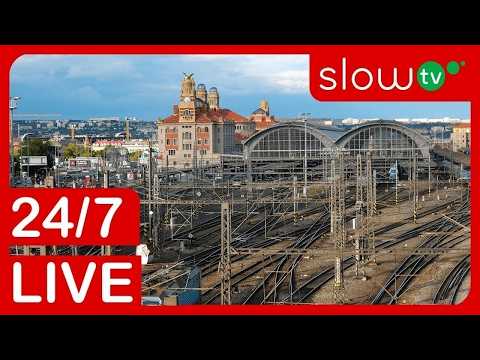
Prague Main Railway Station, Praha hlavní nádraží, is the largest passenger railway station in the Czech Republic and the most important station in Prague. Its history began with a Neo-Renaissance station opened in 1871. At the beginning of the 20th century it was rebuilt and enlarged in Art Nouveau style under architect Josef Fanta while rail traffic continued to operate.
The railway webcam adds a completely different dimension to the city page. Instead of a tourist monument, it shows infrastructure in use: arrivals, departures, rolling stock, changing light over the tracks and the practical rhythm of a European capital connected to domestic and international routes. Watching trains is also a useful reminder that Prague’s historic centre is not isolated from the contemporary city.
Prague Main Railway Station lies close to Wenceslas Square, one of the principal commercial and administrative spaces of the city. The square originated with the foundation of the New Town by Charles IV in 1348. Today it forms a long urban axis lined with shops, hotels, offices and cultural venues, with the National Museum dominating its upper end.
For visitors arriving by train, this area is one of the most direct gateways into central Prague. The relationship between station, Wenceslas Square and the historic centre explains why a railway webcam belongs on the same city page as a Charles Bridge view: they represent two stages of the same urban experience, arrival and exploration.
Prague is often described through its towers and spires, and the bridge area makes that character immediately visible. Gothic towers, church domes and rooflines appear at different depths along the river and in the Old Town. The Old Town Bridge Tower is one of the clearest examples because it combines architecture, urban orientation and historical symbolism.
Live images are particularly useful around sunrise, sunset and periods of changing weather. Low light creates stronger relief on stone surfaces; fog can hide distant towers while leaving the bridge close and sharp; after rain, roofs and pavements become darker and more reflective. Watching these changes gives the skyline a temporal dimension that ordinary tourist photography cannot reproduce.
The bridge webcam is most informative when you look beyond the monument itself. Observe how pedestrian density changes, whether groups are moving toward Old Town or Malá Strana, how the Vltava reflects the sky and how visibility alters the depth of the cityscape. Early morning, evening and poor-weather periods can look completely different from the crowded middle of the day.
On the railway view, the key elements are timing and repetition: trains enter and leave, platforms become active and quiet again, artificial lighting takes over after dark and weather can influence visibility across the tracks. Comparing the two webcams at the same moment shows how the same weather system affects historic stone architecture and modern transport infrastructure differently.
A useful way to connect the two views is to imagine a route from Prague Main Railway Station toward Wenceslas Square, continue through the New Town and Old Town, reach Old Town Square and then walk through the historic streets to the Old Town Bridge Tower and Charles Bridge. It is a relatively compact urban journey, but it crosses several distinct layers of Prague.
From Charles Bridge the route can continue into Malá Strana and toward Prague Castle, while from the station the rail network opens the city toward the rest of Czechia and Central Europe. This is why the two webcams work well together: one looks inward at Prague’s historic identity, the other outward at the movement that connects the capital with a much larger territory.
A single postcard view of Charles Bridge can make Prague seem almost entirely medieval, while a railway image alone could make it look like any busy Central European city. Putting the views together creates a more accurate picture. The historic centre remains active because it is embedded in a living city with transport, residents, workers, visitors and changing daily routines.
This is the principle behind Webcam OK city pages: each live view should add a different piece of information. As new Prague cameras are added, the same guide can expand toward Prague Castle, Old Town Square, the Vltava embankments, Žižkov, Vyšehrad or other districts without repeating a generic description of the city.
The different live views make it possible to compare districts, light, visibility and city movement at the same moment. The guide grows with the archive, keeping each webcam connected to the place it actually shows.


