PortMiami: cruise ships within a working bay
The catalogue associates this webcam with Miami’s cruise port. PortMiami occupies an island setting in Biscayne Bay between the mainland centre and Miami Beach, making its geography as important as the ships. It is a working facility with passenger and cargo functions, not simply a seafront attraction. The catalogue does not identify the camera’s mounting point, a particular terminal or the direction of its view. Those details should remain open rather than being inferred from a generic port label.
An island port and a connected city
Dodge Island and adjoining port land organise berths, terminals, roads and freight activity within the bay. Downtown Miami lies on the mainland, while Miami Beach occupies the Atlantic side beyond the bay. Their proximity creates the familiar metropolitan maritime setting, but water separates routes and access. The visible distance to a building or shoreline is not the same as a permitted walking route.
PortMiami’s twentieth-century move to an island home helped support modern cruise and cargo growth. This links the panorama with a larger history of infrastructure: dredging, roads, terminals and the organisation of space enabled new scales of movement. The harbour should therefore be read as an engineered part of the city as well as a stretch of water with ships. The page’s tourist map uses public landmarks rather than marking a speculative camera position inside operational areas.
Cruising and cargo are different parts of the same port
Passenger vessels dominate many popular images because their height and size make them easy to recognise. Cargo operations tell another story, linking the city with markets and supply chains. A cruise-centred camera should not lead to the conclusion that the entire port serves holidays alone. Nor does the absence of a moving ship in one interval indicate that the working port is inactive.
A vessel at berth can be the centre of a complex turnover involving passengers, luggage, provisions and service work. Much of this is not legible from a distant view. The stillness of the hull contrasts with the activity needed before departure. This is one reason a live view can be more revealing than a single postcard: waiting, movement and changes in light give a sense of duration, even when operational detail remains beyond the lens.
Reading the water without treating it as a timetable
Ship movement changes the scale of a bay scene. A large vessel progresses slowly relative to its length, and surrounding craft or shore buildings may help a viewer appreciate that size. Reflections, cloud shadows and surface ripples alter the appearance of the water. These are general characteristics of watching a port, not a claim that a named liner or particular skyline feature has been inspected in this stream.
For a passenger, the practical information comes from the cruise line and port. Confirm the precise terminal, arrival instructions, documentation, transport and check-in window. A ship still visible at berth does not mean boarding remains open, while an image without a ship does not establish a cancellation. Allow the required time for road access and security rather than estimating it from the apparent distance across the bay.
Public places for a wider understanding of the bayfront
Bayfront Park offers a mainland public setting from which to understand downtown’s relation to Biscayne Bay. Farther north, Maurice A. Ferré Park and its museums add cultural and environmental perspectives. They are destinations around the wider waterfront, not features certified within this camera’s field of view. A museum or park visit can complement a port-inspired day without requiring entry into a cruise facility.
PAMM’s modern and contemporary art programme and Frost Science’s aquarium and planetarium address different interests. Choose according to exhibitions and time, and verify current visitor arrangements. Cruise terminals are not a sightseeing shortcut between these public attractions. Keep passenger transfers and independent exploration as separate parts of the itinerary so that neither depends on a presumed path through restricted working areas.
A maritime view with an underwater neighbour
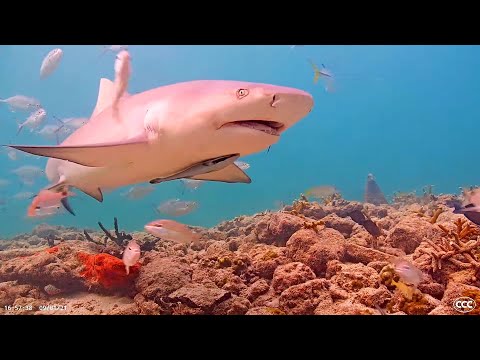
Coral City Camera, listed separately in this collection, documents a marine environment along the eastern end of PortMiami. The relationship is striking: the same urban port landscape can be approached at the scale of ocean-going vessels and at the scale of organisms living beside a reinforced shoreline. These are distinct cameras and subjects. The cruise-port panorama does not demonstrate that its own viewpoint is beside the underwater installation.
Together, the two contexts explain why a bay cannot be described only as scenery. It is transport infrastructure, ecological habitat and part of everyday urban life. Watching responsibly means enjoying visible movement while recognising what the image cannot establish. Weather forecasts, port instructions and environmental research provide evidence for decisions and conclusions that a camera view alone cannot supply.