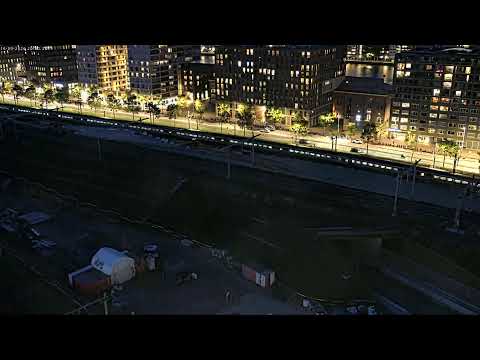
Amsterdam Vijf Bruggen: camera 2
The second Vijf Bruggen camera provides a complementary angle on the same railway project. Compared with camera 1 it helps explain bridge geometry, construction organisation and the relationship with tracks serving Centraal Station.
Vijf Bruggen: railway infrastructure live
The two Vijf Bruggen webcams show an unusual subject for a travel portal: a major railway project evolving in real time. ProRail is replacing five railway bridges immediately east of Amsterdam Centraal, working progressively across the infrastructure.
The value of the cameras lies in change over time. Tracks, temporary structures, construction equipment, trains and parts of the station evolve as work proceeds. They show a different Amsterdam: not only protected historic fabric, but a metropolis constantly renewing the systems that keep it moving.
Amsterdam Centraal: a new gate to the city
Centraal Station dramatically changed Amsterdam's relationship with the IJ. Three artificial islands were created for the station and thousands of piles were driven into the ground. The building, designed by P.J.H. Cuypers with A.L. van Gendt, opened in 1889 and was conceived as a monumental gateway for rail passengers.
Its location was controversial because Stationseiland partly cut the old centre off from the IJ waterfront. Today the station is both a historic monument and a contemporary transport machine in which trains, metro, trams, buses, ferries, bicycles and pedestrians meet.
Stationseiland: mobility and bicycles
Stationseiland is more than the physical base of the station. It is one of the clearest places for understanding Dutch mobility: railway arrivals, trams, buses, pedestrian routes, bicycles and ferries overlap within a relatively small area.
Recent transformation has reorganised routes and moved large amounts of bicycle parking away from the surface. The scale of bicycle facilities makes clear that cycling is part of the city's transport structure rather than a decorative cultural detail.
How to read Amsterdam through its webcams
The nine streams form a sequence. Dam and Damrak show the pedestrian core; Centraal Station and Stationseiland the principal gateway; Vijf Bruggen and PACS C11 infrastructure and works; Dijksgracht the eastern rail and waterfront zone; and the panoramic view the relationship between the city and the IJ.
Different times of day reveal different rhythms. Morning emphasises commuting and logistics, midday brings heavier visitor movement, while evening changes reflections and artificial light. Rain, wind and haze can completely alter the character of the same view.
What this live view reveals
The second Vijf Bruggen camera provides a complementary angle on the same railway project. Compared with camera 1 it helps explain bridge geometry, construction organisation and the relationship with tracks serving Centraal Station.
What to watch live
Compare this view with camera 1 and watch construction phases, trains and changing structures.