Jackson - Jackson Hole Rodeo live
The Jackson Hole Rodeo webcam follows an arena closely associated with local western culture. On competition nights spectators, horses, riders and lighting completely transform the scene.
Jackson Hole Rodeo and western culture
Rodeo has been part of local culture for more than a century. Jackson Hole Rodeo traces its tradition to 1890 and continues to present seasonal competitions including bull riding, barrel racing, roping, bronc riding and other events associated with North American rodeo.
The rodeo webcam changes dramatically with the schedule. On quiet days the arena and stands dominate; on competition evenings the scene fills with horses, riders, spectators and lighting. It is one of the clearest live expressions of Jackson's western identity.
Jackson and Jackson Hole: town and valley
Jackson Hole is the name of the large valley below the Teton Range, not simply a tourism brand. Jackson is the incorporated town in the southern part of the valley and the only incorporated municipality in Teton County. This distinction matters because many attractions marketed as “Jackson Hole” lie outside the town itself.
Jackson concentrates services, restaurants, galleries, lodging and connections toward Grand Teton National Park, Teton Village, the National Elk Refuge and the roads following the Snake and Hoback rivers. The webcams capture precisely this meeting point between a small western town and a much larger mountain landscape.
Cache Street, Broadway Avenue and everyday downtown
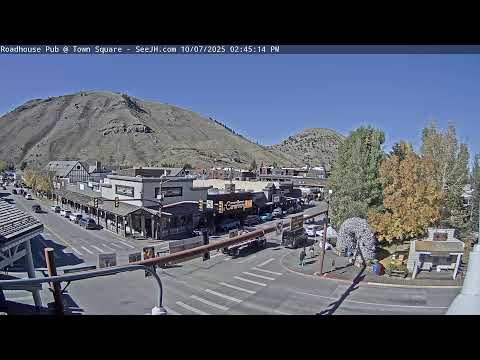
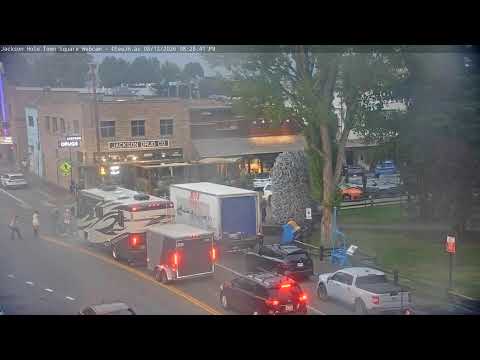
Cache Street and Broadway Avenue are central axes of downtown Jackson. Around Town Square they carry local and visitor traffic past shops, restaurants, galleries, hotels and civic spaces.
Street webcams are particularly valuable because they show Jackson without the idealised postcard view: snow on the road, service vehicles, pedestrians, bicycles, peak traffic and sudden changes in activity during holidays or events.
How to read Jackson through its webcams
The eighteen streams work best as one system. Town Square, Cache Street and Broadway show downtown; Snow King shows the mountain; the rodeo and restaurants show social and western culture; Snake River, Hoback River and Flat Creek connect the town with the natural landscape.
Season changes everything. Winter brings snow, ice and evening lights; spring brings runoff and thaw; summer brings rafting, rodeo and heavier visitor movement; autumn quietens the town and makes the transition toward cold weather increasingly visible.
A human history long before settlement
Archaeological evidence indicates human presence in and around the valley for roughly 11,000 years. Different Indigenous peoples travelled seasonally through the area, following wildlife, waterways and mountain routes as part of wider networks of hunting, gathering, exchange and movement.
Permanent Euro-American settlement came much later. Jackson received its name in 1894 and was incorporated in 1914. In 1920 the town became known for electing an all-female town council, an important episode in local civic history.
Snow King Mountain above Jackson
Snow King rises immediately south of downtown and is a constant presence in the townscape. Local skiing on the mountain dates back to the 1920s, and an organised uphill tow was created in 1939. Snow King is widely described as Wyoming's first ski area.
Today the webcams cover the base, mid-mountain, gondola, lifts and Cowboy Coaster. In winter they focus on snow and skiing; in warmer months they reveal hiking, mountain operations, summer attractions and the remarkably direct relationship between the mountain and downtown.
What this live view reveals
The Jackson Hole Rodeo webcam follows an arena closely associated with local western culture. On competition nights spectators, horses, riders and lighting completely transform the scene.
What to watch live
Watch movement, snow or water when visible, visibility, light, traffic and seasonal change.