Sterling Reef’s Gulf shoreline: white sand, coastal change and the living beach
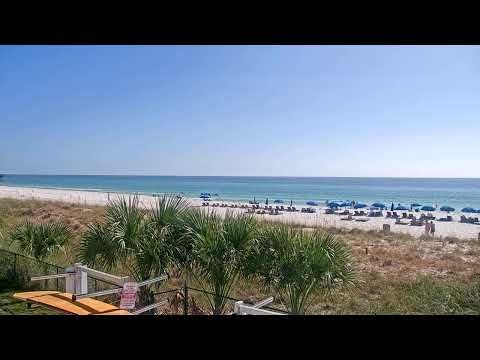
This Sterling Reef entry concerns the same named coastal complex on Front Beach Road, in the broader county-pier area of Panama City Beach. Its most useful subject is the shoreline: the meeting of pale sand, open Gulf water and the developed strip behind the beach. A place name containing “Reef” does not identify a coral reef offshore, and a separate catalogue source does not establish a different camera mounting point. The coastal landscape can be explored in depth without assigning either. It belongs to a regional story of sediments, weather, wildlife and the ways a busy holiday town maintains its main natural attraction.
Beginning with the beach itself
This Sterling Reef entry concerns the same named coastal complex on Front Beach Road, in the broader county-pier area of Panama City Beach. Its most useful subject is the shoreline: the meeting of pale sand, open Gulf water and the developed strip behind the beach. A place name containing “Reef” does not identify a coral reef offshore, and a separate catalogue source does not establish a different camera mounting point. The coastal landscape can be explored in depth without assigning either. It belongs to a regional story of sediments, weather, wildlife and the ways a busy holiday town maintains its main natural attraction.
Where the pale sand comes from
Panama City Beach’s sand is associated with quartz sediments transported from the Appalachian region towards the Gulf and redistributed along the coast. That origin distinguishes it from beaches formed primarily of shells, volcanic rock or coral fragments. The pale appearance is therefore not merely a tourism slogan: it has a geological basis. At ground level, the shore also has several textures and moisture conditions. Dry sand farther from the waves, wet sand at the edge and material moved by a recent tide need not look identical. Appreciating those differences adds detail to an apparently simple band of white beside the water.
Why the same water changes appearance
A coastal image combines several effects at once. Sunlight and cloud cover alter illumination; depth and the seabed influence reflected colour; wind changes the surface; suspended material affects clarity. Their interaction can make the same stretch appear emerald, blue, grey or darker at different times. None of those appearances, taken alone, establishes a laboratory assessment of water quality or a reliable swimming forecast. The value for the viewer is observational: recurring changes explain why a beach is a moving environment rather than a fixed scene. Comparing the visible waterline and reflected light can be as interesting as looking for boats or conspicuous activity.
Dunes as part of the working coast
The upper beach and dune vegetation help form a buffer between open water and buildings behind the shore. Plants trap and retain sand, while the shape of the beach responds to ordinary wave action and stronger weather. A narrow path cut casually across vegetation can damage that structure, which is why designated access matters. Dunes also provide a different living environment from the wet waterline. Not every vegetated area beside a resort is publicly accessible, so a visitor should distinguish a signed route from landscaping or private property. Respecting those boundaries protects both the coast and the people who use it.
Beach maintenance and the history of restoration
The resort shoreline is a natural landscape within a managed visitor destination. Panama City Beach’s published renourishment information describes projects that replaced sand lost from selected coastal sections after storms. Such work helps explain why the width or profile of a familiar beach may change between visits. It does not justify claiming that construction is currently taking place at Sterling Reef or that a particular patch in an image belongs to a named project. The broader lesson is that conservation, engineering and tourism overlap: maintaining a usable shore involves more than keeping the sand tidy after a busy afternoon.
Wildlife behind an apparently empty scene
The local coast is also used by nesting sea turtles and shorebirds. Panama City Beach Turtle Watch documents a long-running local effort to protect turtle nests; wildlife conservation is part of the destination’s everyday story rather than a separate attraction. An empty-looking stretch can contain marked protection areas or important habitat, even when no animal is visible. Observe from a respectful distance, follow instructions around nests and avoid disturbing dune vegetation. A beach walk can become more informative through attention to tracks, habitat and signs, without approaching animals or assuming that a camera will capture a rare wildlife event.
Connecting coastal observation with a visit
The nearby county-pier district offers a practical complement to this shoreline perspective: public beach access, a walk out over the water and recreation facilities can help a visitor experience the coast from more than one level. Beyond the developed strip, Conservation Park explains the inland wetland landscape, while Man in the Sea Museum introduces the human history of exploring below the surface. These are separate places to visit, not presumed visible landmarks. Plan them according to interests and conditions, and use official beach advice for swimming decisions. Sterling Reef’s shore becomes more interesting when white sand is understood as part of an active coastal system rather than simply a backdrop to accommodation.