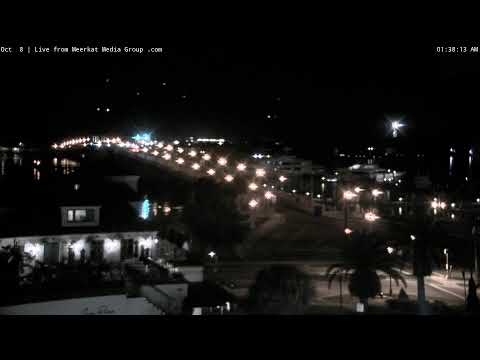
St. Augustine skyline: reading the layers of a waterfront city
The skyline entry invites a broader reading of St. Augustine than a single monument. The catalogue provides a city subject but does not identify the camera’s mounting location, orientation or individually visible buildings. The skyline is therefore approached through the city’s documented architectural layers.
Several periods in one city
Spanish colonial planning, the seventeenth-century Castillo and the grand hotels of the late nineteenth century belong to different chapters. The former Ponce de Leon Hotel and Alcazar, both opened in 1888, express Flagler-era winter tourism. A picturesque architectural style alone is not reliable evidence of a building’s age.
Light gives a changing scale
A city panorama can look flatter in haze and more articulated under clear light. Roofs, trees and water respond differently as cloud and brightness change. Such effects help explain why a familiar skyline may seem unfamiliar at another hour; they do not establish an unseen landmark’s position.
From a panorama to street-level history
Follow the central plaza and Aviles Street, then compare the Flagler buildings and Lincolnville. These walks reveal building uses and community histories that a distant view cannot resolve. The lighthouse belongs to Anastasia Island and Fort Mose to the northern area: both enrich an itinerary without being claimed as visible here.
The plaza and the city’s underlying structure
A skyline can suggest a compact cluster of historic architecture while concealing the plan that gives those buildings meaning. In St. Augustine, the central plaza and surrounding street network are essential to that structure. Religious, governmental and commercial functions accumulated around a public space within a town organised by Spanish colonial planning. Moving from the waterfront into the plaza changes the scale from a distant composition to a sequence of entrances, uses and routes. That street-level relationship is more useful than trying to name indistinct towers from an unverified viewpoint.
Aviles Street and St. George Street then offer different ways to follow the historic fabric. Surviving structures, later additions and reconstructed buildings require separate interpretation. A coherent-looking streetscape can contain several dates and building histories; visual harmony is not evidence that everything was built at once.
Flagler-era architecture and the reinvention of an old city
The former Hotel Ponce de Leon and Hotel Alcazar mark the ambitious resort development associated with Henry Flagler. Their 1888 opening dates place them centuries after the city’s founding. Elaborate revival architecture expressed luxury and regional imagery for winter visitors, supported by transport and service infrastructure. The former Ponce is now part of Flagler College, and the Alcazar houses the Lightner Museum. Their continued use adds another layer to the buildings’ history rather than freezing them at the moment of hotel grandeur.
This is a useful lesson when interpreting any historic-city panorama. Monumental scale and decorative detail can attract attention before modest houses or community institutions, but visual prominence is not the same as historical importance. A complete visit should pair these architectural landmarks with places that tell the histories of workers, African American residents and civil rights campaigners.
A skyline needs the histories that are harder to see
Lincolnville and Fort Mose expand the city beyond its most recognisable silhouettes. Lincolnville’s post-Civil War community and role in the struggle against segregation belong to the modern history of St. Augustine. Fort Mose, north of the centre, interprets an earlier free Black settlement under Spanish rule. Neither subject should be reduced to a decorative district name. Their museums, landscapes and interpreted routes make people and institutions visible in ways that a distant urban view cannot.
A useful itinerary therefore changes scale deliberately: start with the wider impression of the city, walk its central streets, enter an institution with reliable interpretation and give a community-history site time of its own. Add the island lighthouse for a maritime perspective if appropriate. The skyline entry serves as an invitation to this layered city, while the absence of verified frame details prevents assigning particular monuments to the image without evidence.
The Alcazar: from hotel leisure to museum interpretation
The former Alcazar offers a concrete example of how an architectural landmark can change purpose. Its historic indoor pool and recreational spaces belonged to a luxury hotel designed around leisure; the Lightner Museum now presents art, design, collections and the building’s own history. Otto Lightner’s collecting interests add a twentieth-century chapter to the nineteenth-century resort setting. A visit therefore reveals more than the age of an exterior. It asks how people spent their time, what they collected and how a building acquires new public roles. These are street-level and interior stories, not details that can be established by a distant skyline alone.